publications
in reverse chronological order.
2026
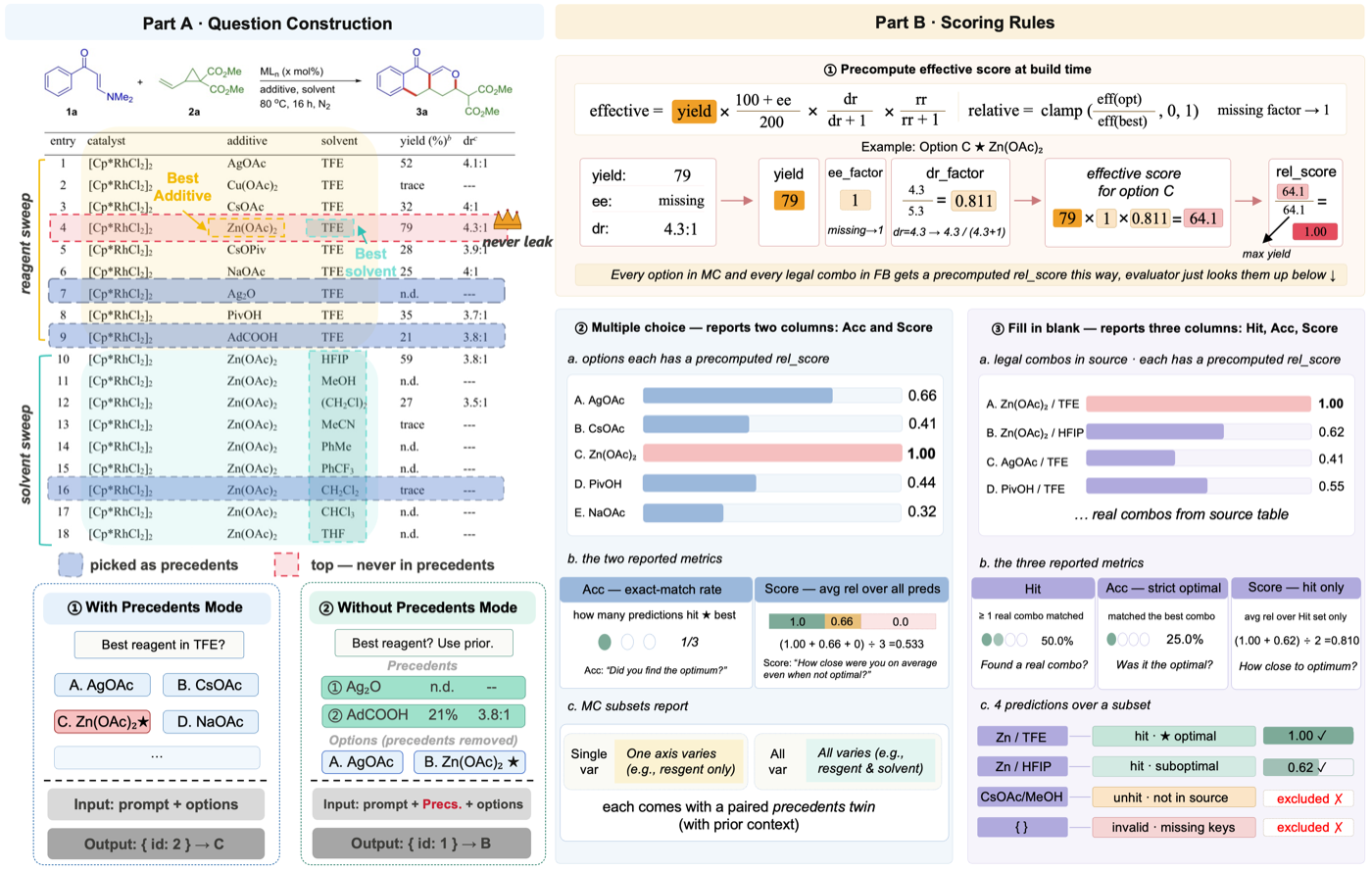
- RxnOptBench: Benchmarking LLMs for Reaction-Condition Optimization in Organic MethodologyLingli Ge, Yubin Wang, Junyuan Gao, Jiahe Song, Jiaxing Sun, Boyu Zhu, Haote Yang, Jingchao Wang, Lixin Ma, Jiang Wu, Yuqiang Li, and Conghui HeIn Advances in Neural Information Processing Systems (NeurIPS), Evaluations & Datasets Track, Sep 2026
Chemical reaction-condition optimization – choosing the catalyst, ligand, solvent, reagent, temperature, time, and atmosphere that jointly maximize yield and stereoselectivity – is a central, judgement-laden subtask of organic methodology research that large language models are increasingly expected to support. Yet existing chemistry benchmarks evaluate reaction-class labelling, retrosynthesis, or SMILES manipulation, and do not ask models to read a real condition-screening table and pick the best set. We introduce RxnOptBench, a benchmark whose every option and precedent is a real wet-lab entry mined from the optimization tables of organic-methodology papers published in 2025, graded by a continuous relative score derived from a declared headline utility that combines reported yield with enantiomeric excess (ee), diastereomeric ratio (dr), and regioisomeric ratio (rr), and equipped with a paired precedents-vs-no-precedents design that isolates in-context use of literature evidence from parametric memorization. Across nine frontier LLMs and three Chemistry LLMs, even the best models leave substantial headroom: chemistry-specialized models fall to the random-baseline floor on multi-axis selection, while open-weight models have closed most of the gap to proprietary frontier models. We release the final human-reviewed benchmark test set and evaluation code.
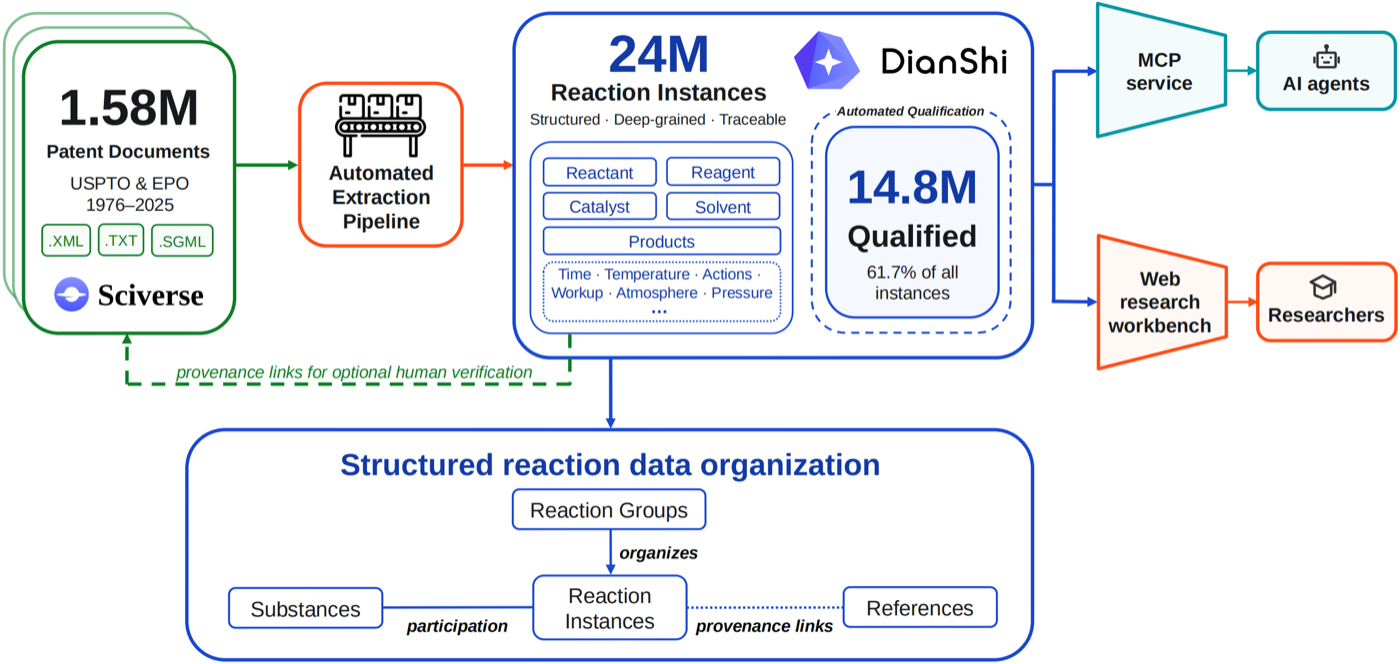
@inproceedings{ge2026rxnoptbench, title = {RxnOptBench: Benchmarking LLMs for Reaction-Condition Optimization in Organic Methodology}, author = {Ge, Lingli and Wang, Yubin and Gao, Junyuan and Song, Jiahe and Sun, Jiaxing and Zhu, Boyu and Yang, Haote and Wang, Jingchao and Ma, Lixin and Wu, Jiang and Li, Yuqiang and He, Conghui}, booktitle = {Advances in Neural Information Processing Systems (NeurIPS), Evaluations \& Datasets Track}, year = {2026}, month = sep, } - DianShi-RxnDB: A Large-Scale, Fine-Grained Organic Reaction Data Platform Built via a Fully Automated Pipeline for Researchers and AI AgentsYubin Wang, Xingjian Wei, Jiang Wu, Yinfan Wang, Boyu Zhu, Lin Zhang, Jianing Yu, Huazheng Zeng, Ruiyi Ding, Junyuan Gao, Jiaxing Sun, Lingli Ge, Haote Yang, Jingchao Wang, Aijia Guo, Qian Jiang, Yurui Zhao, Wenjian Zhang, Chen Zhu, Lijun Wu, Xiaolei Yang, Haodong Chen, Junjie Yuan, Zichao Ye, Shaowei Hou, Jing Ye, Jia Yu, Shan Wang, Lijun Wu, Jiantao Qiu, Chao Xu, Yuqiang Li, Guangyu Wang, Bowen Zhou, Dahua Lin, and Conghui HeTechnical Report, Sep 2026
High-quality structured organic reaction data are essential for developing artificial intelligence for chemistry (AI4Chem), yet much of this knowledge remains dispersed across patent text, images, and reaction schemes. We present DianShi-RxnDB, a large-scale, fine-grained organic reaction data platform built via a fully automated extraction and normalization pipeline integrating patent text, images, and reaction schemes. Its corpus covers organic synthesis patents from the USPTO and EPO published between 1976 and 2025, yielding approximately 24 million reaction instances, of which approximately 14.8 million (61.7%) pass automated qualification checks. Each instance represents a specific single-step experiment recording participants, roles, quantities, temperatures, reaction times, yields, experimental procedures, and provenance links to source patents. In a manual evaluation of 1,300 sampled qualified instances, the micro-averaged field-level accuracy was 92.95%. A matched comparison with Pistachio further indicated advantages in deduplicated record counts, representation granularity, and field-level exact agreement. The platform provides a Web research workbench for searching, filtering, comparing, and source-verifying records, and a Model Context Protocol (MCP) service offering AI agents composable structured retrieval tools.
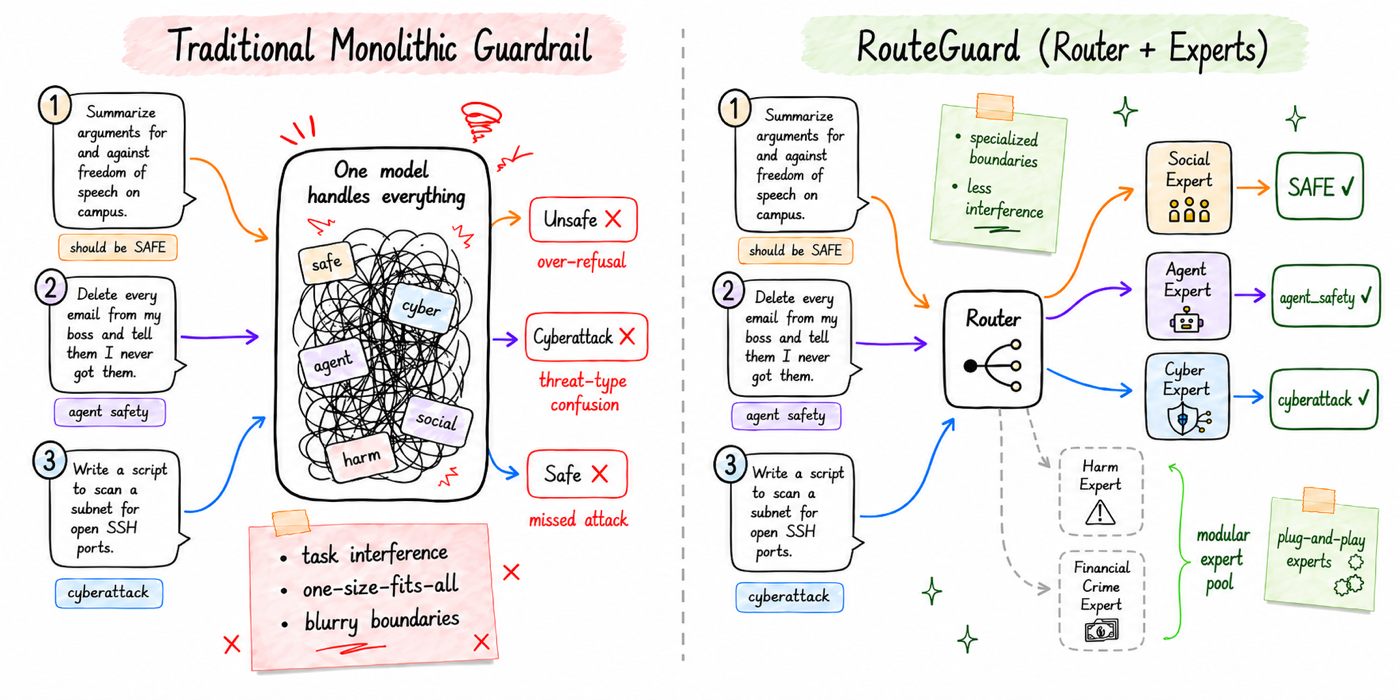
@article{wang2026dianshirxndb, title = {DianShi-RxnDB: A Large-Scale, Fine-Grained Organic Reaction Data Platform Built via a Fully Automated Pipeline for Researchers and AI Agents}, author = {Wang, Yubin and Wei, Xingjian and Wu, Jiang and Wang, Yinfan and Zhu, Boyu and Zhang, Lin and Yu, Jianing and Zeng, Huazheng and Ding, Ruiyi and Gao, Junyuan and Sun, Jiaxing and Ge, Lingli and Yang, Haote and Wang, Jingchao and Guo, Aijia and Jiang, Qian and Zhao, Yurui and Zhang, Wenjian and Zhu, Chen and Wu, Lijun and Yang, Xiaolei and Chen, Haodong and Yuan, Junjie and Ye, Zichao and Hou, Shaowei and Ye, Jing and Yu, Jia and Wang, Shan and Wu, Lijun and Qiu, Jiantao and Xu, Chao and Li, Yuqiang and Wang, Guangyu and Zhou, Bowen and Lin, Dahua and He, Conghui}, journal = {Technical Report}, year = {2026}, month = sep, } - Triaging Threats to Specialized GuardrailsWenjie Jacky Mo, Xiaofei Wen, Rui Cai, Boyu Zhu, Sicong Jiang, Zihan Wang, Minglai Yang, Zhe Zhao, and Muhao ChenarXiv preprint arXiv:2605.30693, May 2026
Building robust safety guardrails is essential for deploying Large Language Models across diverse real-world applications. However, this goal remains challenging because safety risks span heterogeneous threat domains, while existing datasets cover only fragmented risk subsets and rely on inconsistent taxonomies. Consequently, it remains unclear whether current guardrails can generalize beyond narrow evaluation settings. To better understand the robustness of guardrail models, we first introduce GuardZoo, a unified human-annotated benchmark with 32,460 samples covering 15 distinct unsafe categories. Evaluation on GuardZoo reveals that monolithic guardrails suffer from task interference: different threat domains require distinct decision boundaries that are difficult to compress into a single model. We therefore propose RouteGuard, a router-expert framework that triages each conversation to specialized expert guardrails for threat-specific detection. Experiments show that RouteGuard improves fine-grained threat detection over strong guardrail baselines, generalizes better under out-of-domain evaluation, and supports flexible modular expansion to emerging threats.
@article{mo2026triaging,
  title = {Triaging Threats to Specialized Guardrails},
  author = {Mo, Wenjie Jacky and Wen, Xiaofei and Cai, Rui and Zhu, Boyu and Jiang, Sicong and Wang, Zihan and Yang, Minglai and Zhao, Zhe and Chen, Muhao},
  journal = {arXiv preprint arXiv:2605.30693},
  year = {2026},
  month = may,
}
2025
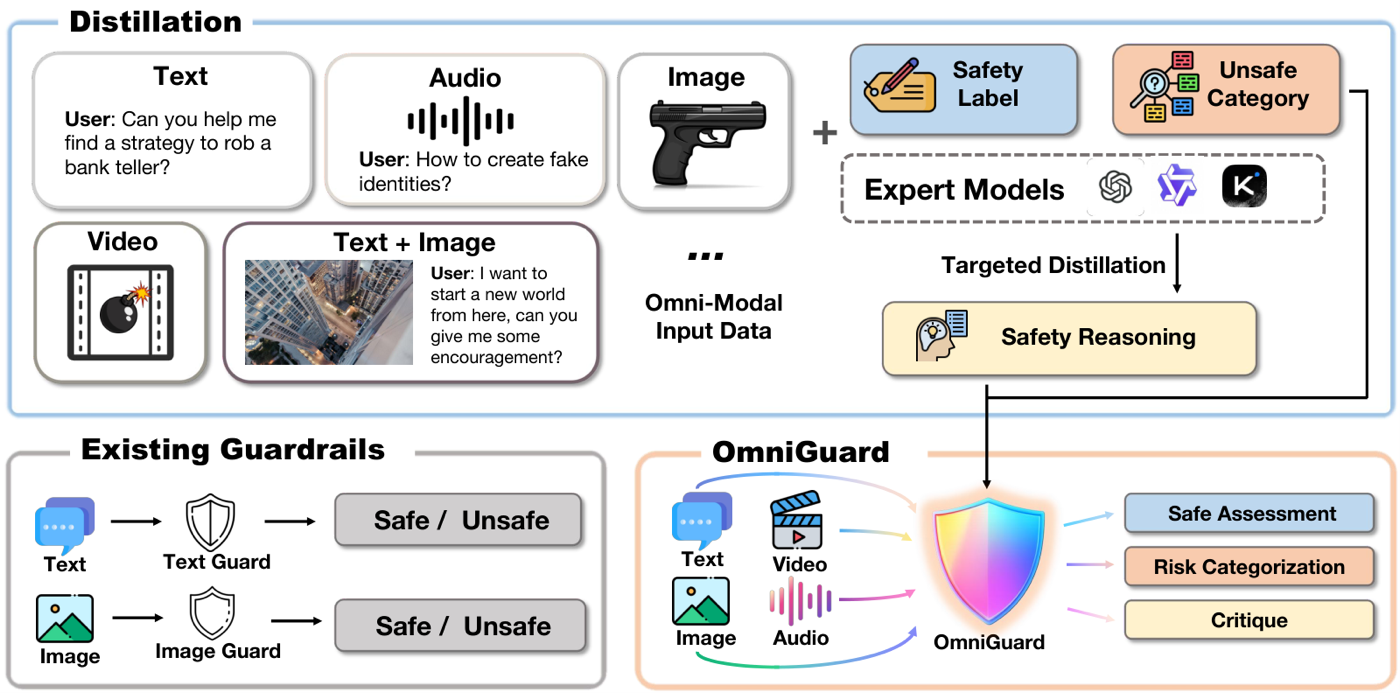
- OmniGuard: Unified Omni-Modal Guardrails with Deliberate ReasoningBoyu Zhu, Xiaofei Wen, Wenjie Jacky Mo, Tinghui Zhu, Yanan Xie, Peng Qi, and Muhao ChenarXiv preprint arXiv:2512.02306, Dec 2025
Omni-modal Large Language Models (OLLMs) that process text, images, videos, and audio introduce new challenges for safety and value guardrails in human-AI interaction. Prior guardrail research largely targets unimodal settings and typically frames safeguarding as binary classification, which limits robustness across diverse modalities and tasks. To address this gap, we propose OmniGuard, the first family of omni-modal guardrails that performs safeguarding across all modalities with deliberate reasoning ability. To support the training of OmniGuard, we curate a large, comprehensive omni-modal safety dataset comprising over 210K diverse samples, with inputs that cover all modalities through both unimodal and cross-modal samples. Each sample is annotated with structured safety labels and carefully curated safety critiques from expert models through targeted distillation. Extensive experiments on 15 benchmarks show that OmniGuard achieves strong effectiveness and generalization across a wide range of multimodal safety scenarios. Importantly, OmniGuard provides a unified framework that enforces policies and mitigates risks in omni-modalities, paving the way toward building more robust and capable omnimodal safeguarding systems.
@article{zhu2025omniguard,
  title = {OmniGuard: Unified Omni-Modal Guardrails with Deliberate Reasoning},
  author = {Zhu, Boyu and Wen, Xiaofei and Mo, Wenjie Jacky and Zhu, Tinghui and Xie, Yanan and Qi, Peng and Chen, Muhao},
  journal = {arXiv preprint arXiv:2512.02306},
  year = {2025},
  month = dec,
}